

>
What Records Must an Executor Keep in Alberta?
Wills & Estates
What Records Must an Executor Keep in Alberta?
9 min read
min
What Records Must an Executor Keep in Alberta?
Introduction
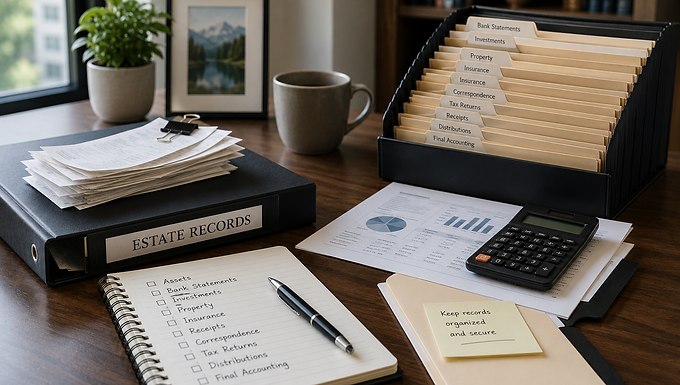
Most executors expect that administering an estate will involve gathering assets, paying debts, and eventually distributing the estate to the beneficiaries. What many do not anticipate is that one of their most important responsibilities is keeping detailed records of every significant decision, financial transaction, and document throughout the administration.
Good record keeping is not simply good organization, it is one of the best ways to protect both the estate and the executor. Beneficiaries are generally entitled to receive an accounting of how the estate was administered, and an executor may be required to explain every dollar received and spent. If questions arise months or even years later, complete records can demonstrate that the executor acted honestly, reasonably, and in accordance with their legal duties.
For that reason, executors should keep comprehensive records from the day they begin acting until long after the estate has been fully administered. Careful record keeping helps avoid disputes, simplifies tax reporting, supports the executor's accounting, and can significantly reduce the risk of personal liability.
What Does Estate Record Keeping Mean?
Estate record keeping refers to maintaining a complete and organized record of everything the executor does while administering an estate.
These records should allow another person, including the beneficiaries, an accountant, or the Court, to understand:
what assets belonged to the estate;
what money was received;
what expenses were paid;
why decisions were made;
how estate property was managed; and
how the final distribution was calculated.
An executor should assume that every transaction may one day need to be explained.
What Does Alberta Law Say?
Under Alberta's Estate Administration Act, executors (referred to in the legislation as personal representatives) have a duty to administer the estate honestly, in good faith, and with reasonable care. Part of fulfilling those duties is maintaining accurate financial records and being prepared to account to beneficiaries when required.
If beneficiaries request an accounting or the Court orders a formal passing of accounts, the executor must be able to demonstrate how estate assets were managed throughout the administration.
Good records protect everyone involved. They allow beneficiaries to understand what occurred, assist accountants in preparing tax returns, and provide evidence that the executor fulfilled their legal obligations.
What Records Should an Executor Keep?
An executor should maintain records from the very beginning of the administration. It is much easier to keep organized records as events occur than to reconstruct them months later.
Estate Bank Account Records
Where appropriate, executors should open a dedicated estate bank account and maintain copies of:
monthly bank statements;
deposit records;
cancelled cheques or electronic payment confirmations;
bank drafts;
wire transfers;
interest earned; and
account closing documents.
Estate funds should generally never be mixed with the executor's personal finances.
Receipts for Every Expense
Every payment made from the estate should be supported by documentation.
Examples include receipts for:
funeral expenses;
property taxes;
utilities;
insurance premiums;
legal fees;
accounting fees;
appraisal costs;
maintenance and repairs;
storage costs;
locksmith services;
travel expenses incurred for estate business; and
courier and postage charges.
If a receipt cannot be obtained, the executor should make a written note explaining the expense, the amount paid, the date, and why it was necessary.
Income Received by the Estate
Executors should also maintain records of every dollar received by the estate.
This may include:
proceeds from the sale of real estate;
investment redemptions;
bank account balances;
CPP Death Benefit payments;
insurance proceeds payable to the estate;
tax refunds;
rental income;
business income;
refunds from service providers; and
money recovered from debtors.
Each deposit should be supported by documentation showing its source and amount.
Investment Records
If the deceased owned investments, retain copies of:
investment statements;
redemption confirmations;
dividend statements;
GIC maturity documents;
share transfer documents;
capital gains calculations;
investment advice received; and
records of any investment decisions made during the administration.
These documents are often essential for preparing the estate's tax returns.
Real Estate Records
Where the estate includes real property, the executor should retain documentation relating to:
property insurance;
mortgage statements;
utility accounts;
property tax notices;
repair invoices;
maintenance costs;
real estate appraisals;
listing agreements;
purchase and sale documents;
lawyer's trust statements;
Land Titles documents; and
records of occupancy or vacancy inspections.
Because real estate is frequently the estate's most valuable asset, detailed records are particularly important.
Personal Property Inventory
Executors should prepare and maintain an inventory of valuable personal property, including:
jewelry;
artwork;
collectibles;
firearms (where applicable);
vehicles;
recreational equipment;
antiques;
electronics; and
other significant household contents.
Photographs taken shortly after death can also be helpful in documenting the condition and contents of the estate.
Correspondence and Communications
Estate administration often involves communicating with numerous people and organizations over many months.
Executors should retain copies of all significant correspondence, including communications with:
beneficiaries;
lawyers;
accountants;
financial institutions;
insurance companies;
Canada Revenue Agency;
Service Canada;
Alberta registries;
real estate professionals;
investment advisors;
pension administrators;
creditors; and
utility providers.
Where important conversations take place by telephone or in person, it is good practice to make a written note recording:
the date and time;
the name of the person spoken to;
the organization they represent;
the issues discussed;
any decisions made; and
any follow-up required.
These notes can be invaluable if questions arise later about what was said or agreed upon.
Tax Records
One of the executor's most important responsibilities is ensuring that all required tax obligations are addressed.
Executors should retain copies of:
the deceased's previous income tax returns;
the final T1 Income Tax Return;
any optional returns prepared;
T3 Trust Income Tax and Information Returns, where required;
Notices of Assessment and Reassessment;
correspondence with Canada Revenue Agency;
tax payment confirmations;
capital gains calculations;
supporting schedules prepared by the accountant; and
the CRA Clearance Certificate, where obtained.
These documents should remain with the estate records even after the administration has been completed.
Records of Distributions to Beneficiaries
Every distribution made from the estate should be carefully documented.
Executors should retain:
copies of all cheques or electronic transfers;
signed receipts acknowledging payment;
Release or Receipt and Release documents signed by beneficiaries;
interim distribution calculations;
final distribution calculations;
correspondence explaining the distributions; and
confirmation that each beneficiary received the amount intended.
Maintaining these records helps demonstrate that the executor distributed the estate in accordance with the will and the estate accounts.
Records of Executor Decisions
Not every important action involves money.
Executors should also keep records explaining significant decisions made during the administration.
Examples include:
deciding when to sell real estate;
obtaining appraisals;
choosing investment strategies during the administration;
retaining professional advisors;
settling creditor claims;
deciding whether property should be repaired before sale;
determining whether personal property should be sold or distributed; and
decisions affecting the administration timeline.
Where professional advice is obtained, retain copies of written advice together with notes explaining why decisions were made.
Documenting the reasoning behind major decisions demonstrates that the executor exercised reasonable care and acted in the best interests of the estate.
Digital Records
Much of today's estate administration occurs electronically.
Executors should preserve electronic records, including:
emails;
scanned receipts;
electronic bank statements;
online investment statements;
digital invoices;
PDF tax documents;
photographs of estate assets;
electronic spreadsheets tracking estate finances; and
secure backups of important documents.
Maintaining both electronic and paper records, where practical, provides additional protection against accidental loss.
How Long Should an Executor Keep Records?
There is no single rule that applies to every estate, and the appropriate retention period may depend on the circumstances.
As a practical matter, executors should generally retain complete estate records for several years after the administration has concluded. This is particularly important where tax matters remain open, questions may arise from beneficiaries, or future inquiries from Canada Revenue Agency are possible.
Many estate professionals recommend retaining estate records for at least six years after the estate administration has been completed, as this often aligns with important tax record retention practices. Depending on the circumstances, longer retention may be advisable.
Before destroying any estate records, an executor should consider obtaining legal or accounting advice.
Practical Examples
Example One: Complete Financial Records Prevent a Dispute
Jennifer administers her father's estate over an eighteen-month period.
Throughout the administration she maintains an electronic spreadsheet recording every deposit, payment, reimbursement, and distribution. She keeps every receipt, bank statement, invoice, and email in organized electronic folders.
When one beneficiary later questions several expenses, Jennifer is able to immediately produce supporting documentation for every transaction. The issue is resolved quickly without formal court proceedings.
Example Two: Missing Receipts
David pays several property maintenance expenses from estate funds but does not retain the receipts.
When beneficiaries later review the estate accounts, they question numerous withdrawals from the estate bank account.
Although David acted honestly, he struggles to prove what the money was spent on because no supporting documentation exists. A simple filing system would have avoided much of the disagreement.
Example Three: Detailed Notes Protect the Executor
Karen receives conflicting instructions from several beneficiaries regarding the sale of estate property.
After each discussion, she records who she spoke with, what was discussed, and the reasons for her decisions after obtaining legal advice.
When concerns are later raised about the timing of the sale, Karen's contemporaneous notes clearly demonstrate that she acted reasonably and in the best interests of the estate.
Common Mistakes
Throwing Away Receipts
Small expenses can add up over the course of an estate administration.
Every receipt should be retained, regardless of the amount.
Mixing Estate Funds With Personal Funds
Estate money should generally pass through a dedicated estate account.
Mixing personal and estate funds creates unnecessary confusion and can make preparing the estate accounting much more difficult.
Relying on Memory
Executors often believe they will remember important conversations or decisions months later.
They rarely do.
Keeping written notes immediately after important discussions is one of the simplest and most effective record-keeping practices.
Waiting Until the End to Organize Records
Attempting to reconstruct months of financial activity shortly before distributing the estate is time-consuming and increases the likelihood of errors.
Records should be organized continuously throughout the administration.
Keeping Only Paper Copies
Paper records can be lost, damaged, or destroyed.
Scanning important documents and maintaining secure electronic backups provides valuable protection.
Costs and Considerations
Maintaining organized estate records generally costs very little compared to the potential cost of correcting mistakes later.
Depending on the complexity of the estate, executors may choose to use:
accounting software;
electronic spreadsheets;
cloud-based document storage;
secure digital scanning services;
bookkeeping assistance;
legal guidance; or
accounting support.
The modest cost of maintaining proper records is often outweighed by the time saved during tax preparation, estate accounting, and the final distribution of the estate.
When Should You Speak With an Estate Lawyer?
Professional advice may be appropriate if:
beneficiaries request a formal accounting;
you are uncertain what records should be retained;
estate funds have accidentally been mixed with personal funds;
receipts have been lost;
beneficiaries dispute expenses;
significant tax issues exist;
the estate includes a business or multiple real estate holdings;
you are concerned about potential personal liability; or
the administration has become contentious.
Obtaining advice early can often prevent record-keeping issues from becoming larger legal disputes.
How Bridgestone Law Can Help
Proper record keeping is one of the foundations of successful estate administration. Accurate records help protect beneficiaries, simplify tax reporting, support the executor's accounting, and significantly reduce the risk of unnecessary disputes.
Bridgestone Law assists executors and families throughout Calgary and Alberta with probate applications, estate administration, estate accounting, and executor guidance. We can help you understand what records should be maintained, organize your estate administration, and ensure your legal obligations are met with confidence.
Related Articles...












Receive practical legal updates and new resources from Bridgestone Law.

QUICK LINKS
PRACTICE AREAS
Wills & Estates
Probate Services
Family Law
Mediation (ADR)
Domestic Contracts
Litigation
Notary Services
CONTACT